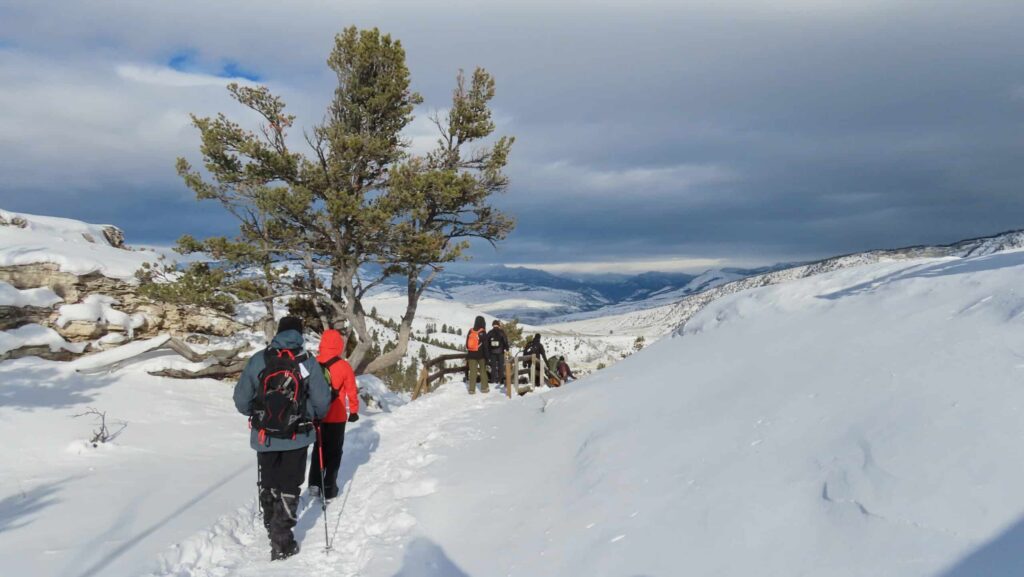
Imagine having Yellowstone National Park all to yourself. It might feel like you do if you visit in the winter. Travelers on Backroads’ Yellowstone & Tetons Snow Adventure Tour get that kind of no-one-else-is-around experience as they snowshoe across powder-covered landscapes and take in the park’s geysers and fumaroles through a wintery lens.
“Winter is kind of a hidden gem for national parks,” says Liz Einbinder, head of partnerships and PR at active and adventure travel expert Backroads. “It’s a great opportunity to see wildlife in a different setting, and with fewer people around, the experience often feels more peaceful and immersive.”
Summer is peak season for many U.S. national parks, coinciding with school vacations and sunshine-filled days ideal for taking in all that natural beauty. But if you have the flexibility to visit the parks during the fall or winter, you can enjoy a bit more serenity (thanks to smaller crowds) and some special seasonal experiences.
“Visiting in fall and winter allows you to see the landscapes alive with autumn colors or blanketed in freshly fallen snow,” says Matt Cotter, senior director of program management at education-driven tour operator Road Scholar. “And if you enjoy (or at least don’t mind) the snow, visiting in winter months gives you the option to try some winter sports, like cross-country skiing, snowshoeing, or even dogsledding, and to see snow-dusted buffalo or wintering elk.”
Rising interest leads to increased opportunities
National park tours are always a popular offering at Road Scholar, and other travel tour companies have been seeing similar strong interest. Backroads increased its 2026 U.S. national park trip departures by 12% over 2025 to meet demand and expects interest to remain high in 2027.
Intrepid Travel has taken more than 25,000 people to U.S. national parks since 2009 and will add some 5,000 more by the end of 2026. And with its U.S. national park itineraries for 2027 trending about 20% ahead of the same point last year, and with nearly every itinerary outpacing 2026, Tauck is adding capacity across its portfolio to accommodate that interest.
“We’re seeing travelers increasingly look for new ways and new times of year to experience these iconic places, whether that means returning to a favorite park in a different season or experiencing it beyond the traditional summer months,” says Kelly Coughlan, brand manager for Tauck. “Yellowstone is a good example of how that interest is evolving. By 2027, Tauck will offer ways to experience Yellowstone during 11 months of the year, from its classic summer season to spring, fall, and even winter.”
The benefits of traveling in a group

Visiting a national park on a travel tour can have some distinct advantages. Logistics, lodging, transportation, entry fees, and needed equipment in many cases are all taken care of by the tour company, making it easier for travelers to simply soak in the scenery. “With a local leader by your side, you’ll have an opportunity to explore the most iconic sections of America’s parks, as well as lesser-known gems you won’t find in the travel guides,” says Leigh Barnes, Intrepid Travel president for North America.
“Avoiding crowds is a skill, not luck,” says Bogdana Hart, regional operations manager, North America, for G Adventures. “Knowing to hit a viewpoint at sunrise or after the day-trippers leave is local knowledge, and it is the difference between wasted time and enjoyed time.”
And when you consider the sheer scale of the parks, insider insight is a valuable perk. “The average size of a U.S. national park is 1,300 square miles. It can be a challenge to know where to go,” says Cotter. “Road Scholar Group Leaders are local experts, often naturalists, who not only know where to take you, when, and at what pace, but they also provide educational context along the way, so you can learn about the flora, fauna, and natural history of the park you’re visiting.”
When issues pop up, tour groups have the know-how needed to pivot. “If there are unexpected road or trail closures, a guidebook or on-the-go internet research won’t compare with a tour operator’s experience,” says Hart. “A guided group gets rerouted by a team of experts, but an independent itinerary just breaks.”
Group travel can also play a part in protecting these precious parcels by helping to reduce the number of vehicles on park roads and having experts on hand to encourage and inspire adherence to park rules and regulations. You can take those efforts even further by booking an experience like Intrepid’s Active-ism trips, which launched in 2025 in response to moves by the federal government impacting staffing and funding levels at U.S. national parks. The small group trips led by environmentalists and other changemakers blend adventure with social impact, helping travelers both explore national parks while also learning about the work that goes into protecting them.
“Tourism plays an important role in supporting both people and protected areas,” says Barnes. “We launched our Active-ism trips to help raise awareness and foster discussion around the challenges facing U.S. national parks, while empowering travelers to advocate on their behalf and have a more meaningful travel experience.” Intrepid’s 2026 Active-ism trips included visits to Zion, Grand Canyon, Yosemite, Yellowstone, and Grand Teton National Parks, and 2027’s lineup is still being determined.
Plan your own off-season adventure

If you’re inspired to plan your own fall or winter visit to a national park, here are some travel tour options that still have availability for late 2026 and early 2027:
With departures from late October through March, Road Scholar’s Hiking Death Valley National Park and the Valley of Fire trip takes full advantage of the cooler time of year at this often steamy national park. The itinerary includes a hike along the rim of Ubehebe Crater and a visit to Badwater Basin, the lowest point in North America.
Other Road Scholar national park trips with availability for fall or winter include Heart of the Winter in Yellowstone, offering excellent winter wildlife watching; Florida’s Natural Treasures: Hike, Bike & Kayak the Everglades, offered at a time of year when it’s actually pleasurable to visit the unique national park; and Hiking the High Desert: Joshua Tree National Park & Palm Springs, with hikes through scenic spots like the park’s “Wonderland of Rocks” area.
Intrepid’s Western USA National Parks Loop tour includes visits to Zion, Bryce Canyon, and Grand Canyon National Parks, as well as Monument Valley and Antelope Canyon. Fall departures typically feature a sunrise viewing at the rim of the Grand Canyon.
If you’re short on time, Backroads’ four-day Arizona’s Saguaro National Park Hiking & Walking Tour gets you out into Saguaro National Park at an ideal time of year (the months of December, January, and February). So you won’t be sweltering while admiring giant saguaros, desert rock formations, and views of the Rincon Mountains.
Backroads also still has space on its Palm Springs & Joshua Tree Multi-Adventure Tour and Death Valley Hiking & Walking Tour for exploring those California national parks during the fall and winter.
Guests travel by snowcoaches to remote parts of Yellowstone National Park during Tauck’s Wonderland: Yellowstone in Winter tour. “In winter, snow-covered landscapes, visible wildlife, and steam rising from geysers and hot springs create a dramatically different experience,” says Coughlan. “Seeing Yellowstone outside of summer can feel like discovering an entirely different park.”
G Adventure’s Best of Utah & Arizona National Parks tour includes visits to Bryce Canyon, Zion, and Grand Canyon National Parks. Book one of the winter 2027 trips for smaller crowds and cooler weather for hiking. “The Southwest is awesome as a cool-season destination,” says Hart. “And the lower sun angle in the winter makes for longer golden hours and better photos.